
Take a breath.
You’ve done the impossible. You moved past the “scrappy startup” phase years ago. You’ve scaled the mountain of $10M, $50M, maybe even $200M in annual revenue. Your operations are sleek. Your logistics are locked down. Your product is objectively better than it was three years ago.
But lately, when you describe what your company does, it feels like you’re trying to squeeze into a suit you bought for your high school graduation. It’s tight in the shoulders. The seams are screaming. It just doesn’t fit the person: or the powerhouse company: you’ve become.
At Sky Nile Consulting, we call this “outgrowing your story.”
In the mid-market world, growth often happens faster than the narrative can keep up with. You’re busy building the plane while flying it, so the brand strategy gets left in the terminal. The result? A disconnect between the massive value you provide and the way the world perceives you.
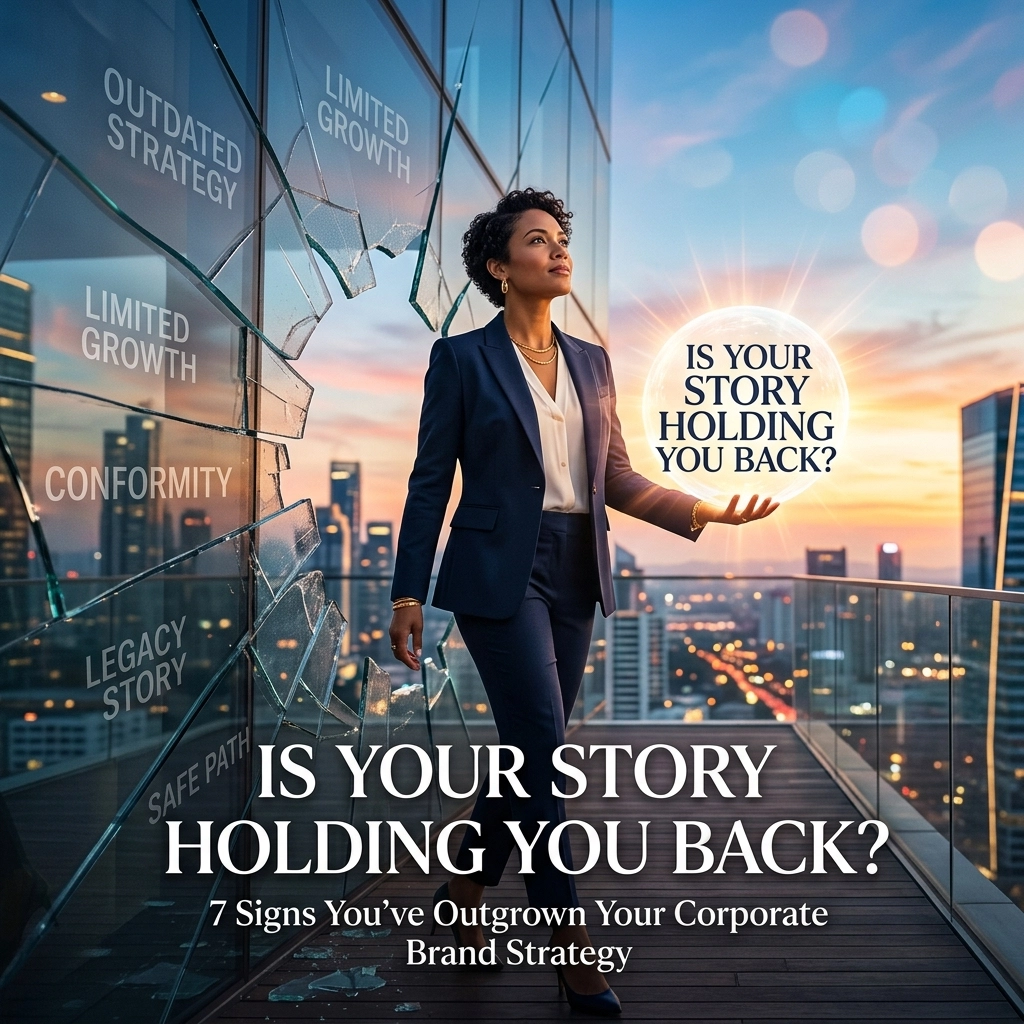
If you suspect your brand is stuck in 2019 while your balance sheet is living in 2026, you aren’t alone. Here are the seven definitive signs that you’ve outgrown your corporate brand strategy: and what to do about it.
1. The Sales Team is Running an Improv Show
Have you ever sat in the back of a sales meeting and wondered if you walked into the wrong company?
When a brand story is outdated or fuzzy, your sales team becomes a group of independent playwrights. Every Account Executive has their own “special” deck. Every regional manager has a different way of explaining your value proposition. One person sells on price; another sells on innovation; a third sells on “we’re just nice people.”
If your team is telling five different stories, you don’t have a brand; you have a collection of talented individuals improvising in the dark. This lack of narrative architecture creates confusion in the market and longer sales cycles.

2. You’re Explaining “What” Instead of “Why”
In the early days, you had to explain what you did because nobody knew you existed. “We make software that tracks widgets.” “We provide HR consulting for small firms.”
But as a mid-market leader, your “what” is likely a commodity now. If your pitch is still 90% features and 10% philosophy, you’ve outgrown your story. Spreadsheets tell people what you do, but stories tell them why it matters.
If you find yourself stuck in the weeds of technical specifications during a first-round meeting, you’re missing the leadership narrative that drives loyalty and high-level buy-in. You need to move from being a vendor to being a visionary partner.
3. The “Frankenstein” Brand (Post-Merger or Leadership Shift)
Maybe you’ve acquired a smaller competitor. Maybe you’ve brought in a new CEO with a fresh vision. Or perhaps you’ve merged with a peer.
M&A activity is a sign of a healthy, growing business, but it’s the fastest way to muddy the brand waters. If your brand looks like a patchwork quilt of different logos, tones, and mission statements, you’re leaking brand equity.
When leadership shifts or companies combine, the “old” story usually doesn’t fit the “new” entity. Without a cohesive storytelling strategy to bridge the gap, your internal teams will feel fractured, and your customers will feel hesitant.
4. You’re Losing to “Noisier” Competitors with Weaker Products
This is the one that really stings.
You know your product is superior. Your retention rates prove it. Your R&D budget is triple that of your nearest rival. Yet, that “other” company: the one with the slick social media, the clear message, and the bold point of view: is winning the hearts and minds of the market.
Why? Because they are telling a better story.
In a crowded market, “better” doesn’t always win. “Clearer” wins. If you are losing ground to competitors who have half your tech but twice your “vibe,” your brand strategy is failing to capture your true value. It’s time to find the story hiding under your spreadsheets and start shouting it from the rooftops.

5. Internal Culture Feels Disconnected from the External Brand
Your brand isn’t just what you tell customers; it’s the heartbeat of your office (physical or virtual).
If your external marketing promises “Innovation and Speed,” but your internal culture is bogged down in “Process and Bureaucracy,” your employees know it. They can feel the friction. When the brand story doesn’t match the internal reality, you get disengagement.
An outdated brand strategy acts like a dull ache in your corporate culture. People want to work for a movement, not just a paycheck. If your team can’t recite your “why” or doesn’t see themselves in the corporate narrative, your growth will eventually stall. Narrative alignment starts from the inside out.
6. Your Website Feels Like a Digital Time Capsule
We’ve all been there. You click on a website and it feels like you just stepped into a time machine set for 2018.
It’s not just the stock photos of people shaking hands or the parallax scrolling that’s gone out of style. It’s the language. If your website reflects who you were three years ago: smaller, more localized, less sophisticated: you are actively turning away the high-value partners you’re trying to attract.
A website should be a reflection of where you are going, not just where you’ve been. If your digital presence doesn’t mirror the scale of your current operations, you’re signaling to the world that you haven’t quite “arrived” yet. Check out our projects to see how we help businesses modernize their narrative ecosystem.
7. You Have “Brand Shame”
This is the ultimate litmus test.
When you’re at a conference or a high-stakes networking event, do you hesitate to send someone to your website? When a prospect asks for your pitch deck, do you find yourself saying, “Ignore the first few slides, we’re actually working on updating those”?
If you feel a twinge of embarrassment when sharing your brand materials, that is your gut telling you that your brand no longer represents your excellence. This “brand shame” isn’t just a minor annoyance: it’s a psychological barrier that prevents you and your leadership team from showing up with the confidence needed to close $10M deals.
The Mid-Market Dilemma: Who Owns the Story?
So, you recognize the signs. You know the story is broken. Now what?
For mid-market companies, the problem is often a lack of dedicated brand leadership. You might have a great Marketing Director, but they are buried in lead gen, SEO, and trade show logistics. They don’t have the “altitude” to reshape the entire corporate narrative.
On the other hand, hiring a full-time, C-suite Chief Brand Officer (CBO) is a massive investment. Between the $300k+ salary, the benefits, and the equity, it’s a heavy lift for a company that needs strategic direction but isn’t quite a global conglomerate yet.
Enter the Fractional Chief Brand Officer

This is where the Fractional CBO model changes the game.
Imagine having an executive-level brand architect who sits at the table with your CEO, COO, and CFO to realign your narrative, audit your message pillars, and ensure your brand strategy is working as hard as your sales team.
At Sky Nile Consulting, we provide that high-level storytelling strategy without the overhead of a full-time executive. We help you:
- Audit the mess: We find out where the narrative is leaking.
- Build the architecture: We create the “Storyteller’s Couch”: a safe space to define your true “why.”
- Align the team: We make sure everyone from the intern to the Board of Directors is singing from the same songbook.
- Execute with clarity: We refresh the visual and verbal identity to match your current revenue reality.
Stop Playing Small
You’ve outgrown your story because you’ve succeeded. That’s a good problem to have! But don’t let a “hand-me-down” brand strategy cap your future growth.
Your brand should be the wind at your back, not an anchor dragging behind you. It should simplify your sales, energize your culture, and make your competitors nervous.
If you’re ready to trade “brand shame” for brand clarity, let’s talk. Your next level of growth is waiting: it just needs a better story to carry it there.
You’re the best!
(Ready to see if we’re a fit? Explore our services. Let’s build a movement together.)